
Meshing
Introduction to Mesh Generation
Mesh generation is a critical step in CAE workflows, converting geometric models into discrete elements suitable for numerical analysis. This page covers various mesh types, quality metrics, refinement techniques, and preprocessing workflows.
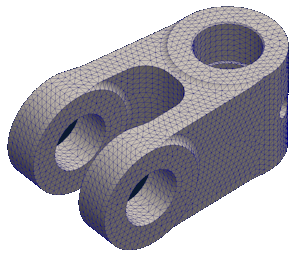
Meshing Basics
Types of Meshes
Common mesh types include:
- Structured Meshes: Grids with regular connectivity, often used for simple geometries.
- Unstructured Meshes: Irregular connectivity allowing flexibility for complex shapes.
- Hybrid Meshes: Combination of structured and unstructured elements to optimize performance.
Mesh Quality Metrics
Key metrics to assess mesh quality include:
- Aspect Ratio: Ratio of element dimensions, ideally close to 1.
- Skewness: Deviation from ideal element shape.
- Orthogonality: Angle between element edges and faces.
- Smoothness: Gradual change in element size.
Mesh Refinement Techniques
Key metrics to assess mesh quality include:
- Adaptive Refinement: Automatically refining mesh based on solution gradients.
- Manual Refinement: User-defined refinement in critical regions.
- h-Refinement: Subdividing elements to increase mesh density.
- p-Refinement: Increasing polynomial order of elements.
Meshing from a Developer's Point of View
For CAE application developers focusing on mesh generation, the following topics are of high interest:
- Generation Algorithms: Detailed exploration of Delaunay triangulation, advancing front methods, octree-based meshing, and hybrid approaches.
- Solver Integration Constraints: Understanding solver-specific requirements and constraints that influence mesh design and quality.
- Quality Control and Metrics: Advanced metrics and automated quality checks tailored for solver accuracy and stability.
- Automation and Scripting: Using APIs, scripting languages, and SDKs to automate mesh generation workflows and customization.
- Geometry Preprocessing: Techniques for robust geometry cleanup, defeaturing, and simplification to ensure meshability.
- Adaptive Mesh Refinement: Strategies for implementing adaptive refinement based on error estimators or solution gradients.
- Parallel and High-Performance Meshing: Approaches to scale mesh generation for large models using parallel computing.
- Data Structures and Mesh Storage: Efficient data structures for mesh representation, adjacency queries, and memory management.
- Validation and Debugging Tools: Tools and techniques to validate mesh integrity and diagnose meshing issues.
- Interoperability and Standards: Support for common mesh formats, CAD interoperability, and standards compliance.