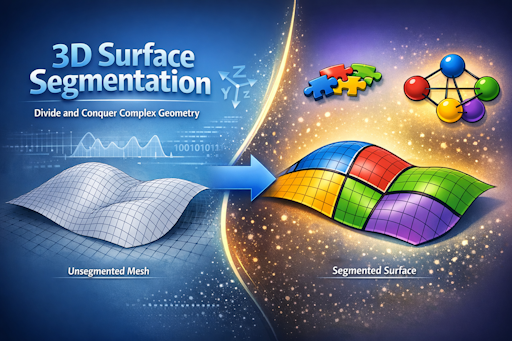
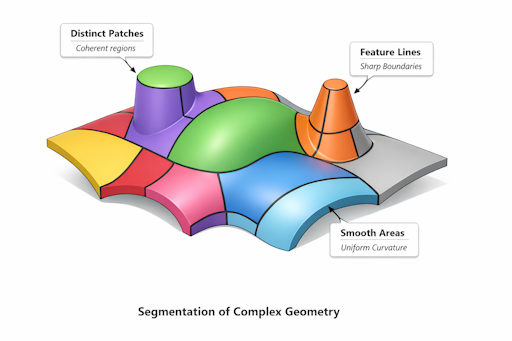
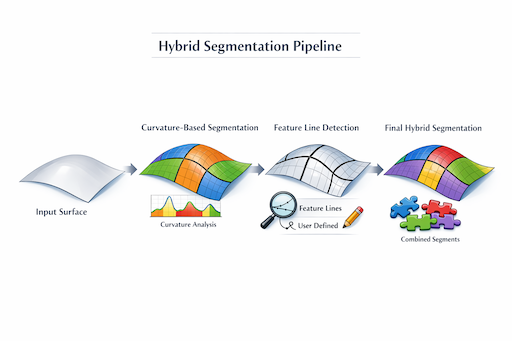
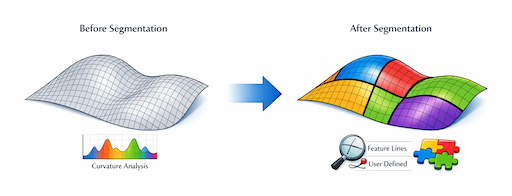
Segmentation serves as the critical link between raw geometry and well-behaved meshes suited for numerical simulation. It partitions continuous
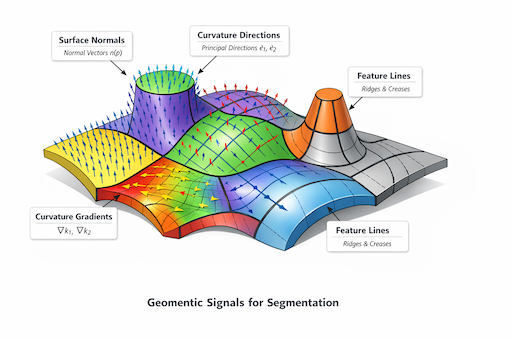
surfaces into coherent regions, each characterized by its unique geometric attributes and meshing requirements. Leveraging differential-geometric
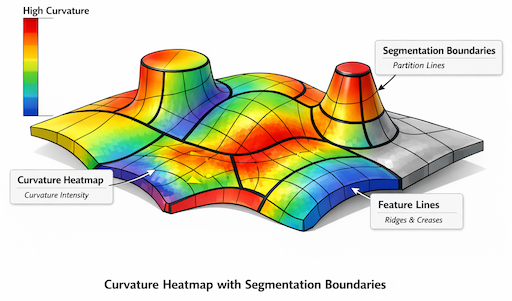
signals—normals, curvature, curvature derivatives, and topological structure—enables the establishment of boundaries that reflect genuine surface
behavior rather than arbitrary divisions.
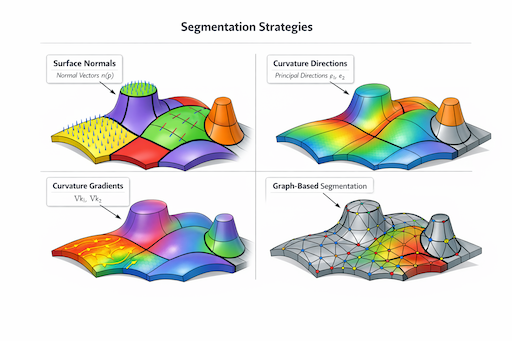
Various segmentation techniques emphasize different aspects of geometry. Feature-line methods capture sharp transitions and essential edges;
curvature-based approaches highlight smooth variation and intricate shapes; spectral and graph-based methods reveal global organization and
bolster robustness. In practice, reliable systems combine these methodologies, utilizing each according to its strengths.
Segmentation fundamentally shapes the resulting mesh, affecting element orientation, refinement patterns, boundary conformity, and the feasibility
of structured or semi-structured meshing. Proper segmentation yields meshes aligned with curvature flow, respects geometric features, and minimizes
distortion. Conversely, inadequate segmentation can introduce compromises, leading to solver instabilities and reduced accuracy.
The outlined guidelines—including respecting feature lines, smoothing signals, integrating multiple cues, validating visually, and iterating alongside
meshing—advance segmentation from theoretical exploration to practical engineering workflow. They ensure that segmentation is both mathematically
rigorous and attuned to the complexities of simulation, manufacturing, and design intent.
As geometrical complexity increases, segmentation's importance grows. It acts as the organizing principle that allows meshing algorithms to scale,
adapt, and remain robust. With a deep understanding of segmentation techniques, engineers can guide the meshing process effectively, unlocking
high-quality simulations across diverse applications.